
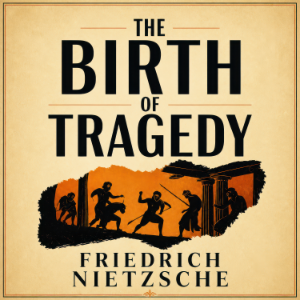
The Birth of Tragedy
Friedrich Nietzsche
Before Socrates, before reason triumphed over instinct, ancient Greece created the highest art humanity has ever known—and then destroyed it.
In his explosive 1872 debut, twenty-seven-year-old Friedrich Nietzsche revolutionized how we understand art,...
Location:
United States
Description:
Before Socrates, before reason triumphed over instinct, ancient Greece created the highest art humanity has ever known—and then destroyed it. In his explosive 1872 debut, twenty-seven-year-old Friedrich Nietzsche revolutionized how we understand art, culture, and human nature. Through a radical reinterpretation of Greek tragedy, he introduced two primal forces that shape all creativity and existence: the Apollonian drive toward order, clarity, and beautiful form, and the Dionysian impulse toward ecstasy, chaos, and the dissolution of boundaries. Greek tragedy achieved greatness, Nietzsche argues, by fusing these opposing forces into a profound affirmation of life—embracing both beauty and suffering, order and chaos, joy and horror. But this golden age was murdered by Socratic rationalism, which denied life's tragic dimensions in favor of logical optimism and the dangerous belief that knowledge could redeem existence. Nietzsche's critique extends far beyond ancient Greece to indict modern Western civilization itself. Our culture, dominated by scientific rationality and Christian morality, has lost the Dionysian capacity to affirm life in all its terrible magnificence. We need logic to make sense of chaos, but we need art to make existence bearable. This isn't merely a scholarly analysis but a passionate manifesto calling for cultural rebirth through the reawakening of tragic wisdom. Controversial, visionary, and deeply prophetic, The Birth of Tragedy announced the arrival of philosophy's most dangerous voice. The work that launched Nietzsche's career—and changed how we think about art, reason, and what it means to be human. Duration - 6h 42m. Author - Friedrich Nietzsche. Narrator - Charles Owen. Published Date - Sunday, 04 January 2026. Copyright - © 2024 David Petault ©.
Language:
English
Opening Credits
Duration:00:00:14
Introduction
Duration:00:36:56
part one: attempt at self criticism — section one
Duration:00:04:59
part one: section two
Duration:00:02:47
part one: section three
Duration:00:02:57
part one: section four
Duration:00:04:35
part one: section five
Duration:00:06:25
part one: section six
Duration:00:03:28
part one: section seven
Duration:00:07:53
part two: the birth of tragedy — section one
Duration:00:13:39
part two: section two
Duration:00:09:52
part two: section three
Duration:00:09:50
part two: section four
Duration:00:11:10
part two: section five
Duration:00:15:24
part two: section six
Duration:00:09:30
part two: section seven
Duration:00:14:17
part two: section eight
Duration:00:18:18
part two: section nine
Duration:00:17:08
part two: section ten
Duration:00:10:00
part two: section eleven
Duration:00:15:36
part two: section twelve
Duration:00:16:36
part two: section thirteen
Duration:00:09:13
part two: section fourteen
Duration:00:12:18
part two: section fifteen
Duration:00:14:03
part two: section sixteen
Duration:00:16:10
part two: section seventeen
Duration:00:16:28
part two: section eighteen
Duration:00:11:48
part two: section nineteen
Duration:00:22:41
part two: section twenty
Duration:00:08:09
part two: section twenty one
Duration:00:19:13
part two: section twenty two
Duration:00:12:03
part two: section twenty three
Duration:00:12:23
part two: section twenty four
Duration:00:12:10
part two: section twenty five
Duration:00:04:06
Ending Credits
Duration:00:00:16